
Lücker, Kellner, Sauter-Servaes, Rüger: “Analysis of Potentially Efficient, Near-Term Realisable and Future Routes for High-Speed Overnight Trains” (Sustainability 2026, 18, 10116)
https://doi.org/10.3390/su181910116
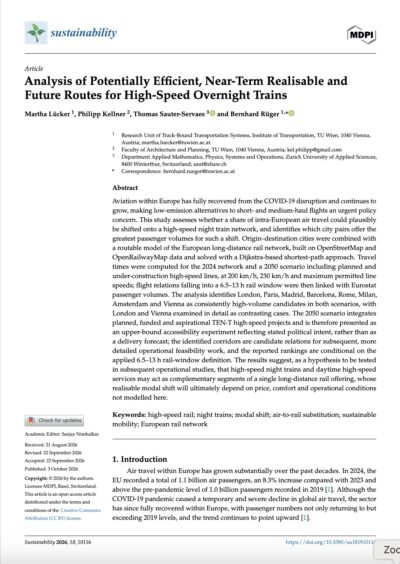
This TU Wien study, written within the DZSF-funded EuroNight 2.0 project, is a welcome step towards a Europe-wide, network-based view of where high-speed night trains could replace flights. It evaluates and builds on our own works within the Back-on-Track network. It models travel times on a routable European rail network for 2024 and 2050, and overlays them with Eurostat air passenger volumes. However, according to our analysis, some modelling choices (a flat delay surcharge, a 13 h cap, a static 2050 demand, an optimistic 2050 network) distort the picture, and the climate figure is introduced without a clear source.
Our full comment:
What the study does. The authors build a routable model of the European long-distance network from OpenStreetMap/OpenRailwayMap data and calculate station-to-station travel times at 200 km/h, 230 km/h and maximum line speed. They then select all city pairs with a rail travel time between 6.5 and 13 h and link them to flight passenger numbers. For 2024 they find 388 relations with about 164.5 million air passengers a year, roughly 29.5% of intra-European air traffic. For 2050, with 54 added expansion projects, they find 530 relations but only 151.6 million passengers. London, Paris, Madrid, Barcelona, Rome, Milan, Amsterdam and Vienna come out on top in both scenarios. London and Vienna are examined in depth as contrasting cases. London is blocked mainly by technical and regulatory barriers, whereas Vienna is a matter of extending and accelerating existing Nightjet connections.
What we welcome:
- The study redevelops our shifting potential model using future travel times instead of distances, similar to how we do in our target network calculation tool. This is the right direction.
- It names regulatory, procurement and timetable-planning decisions, not physics, as the main obstacles to high-speed night trains, and it lists concrete measures: track access charges at marginal cost, harmonised VAT, priority for night paths and fewer locomotive changes.
- It provides the travel time matrices and route-level passenger data as supplementary tables.
- It builds on and evaluates our work: Our French group’s study of passenger potential for two-night trains on long distances, our German group’s study of the GHG reduction potential for high-speed night trains, and our joint study with Transport & Environment on politically determined charges.
Where our own research differs from some of the study’s choices:
- Delays are modelled with a flat 20% surcharge on travel time. The study calibrated this on only three day-train relations (Brussels–Paris, Madrid–Barcelona, Rome–Florence) and itself acknowledges deviations of +9%, +10% and −4%. In our target network tool we apply a per-stop surcharge for deceleration and acceleration, plus an evidence-based, country-specific delta between possible and scheduled travel times. The study flags our approach as a proposal for further research.
- The network is optimistic. The study includes corridors at delivery risk by assigning them delivery by 2050, such as the second track of Rail Baltica and Athens–Thessaloniki–Sofia. It also includes high-speed projects that have been politically ruled out, such as Bordeaux–Bilbao and the Helsinki–Tallinn tunnel and projects for which no route exists, such as the Neue Innkreis Bahn, where travel times cannot be seriously estimated. We decided to exclude projects which are not feasible by 2035.
- The 2050 demand is static, so demand “decreases”. Applying 2024 passenger numbers to 2050 leads to slightly fewer shifting potential from aviation (164.5 → 151.6 million passengers). This is because the network expansion pushes more connections below 6.5 h, which day trains can serve, and because the new connections appear mostly in Eastern Europe, where population density is lower. It might be worth reconsidering the 6.5 h constraint. Even though more passengers prefer day trips of up to 6.5 h today, flight connections only disappear when train travel time falls below about 4 h. Also, assuming a steady growth in mobility demand in line with recent decades might be more realistic than assuming 2024 demand for 2050.
- The 13 h cap cuts off potential. The cap is derived as the midpoint between a 10 h ideal and a 16 h maximum, with the assumption that adding stops can turn 13 h into 15 h. But the study then treats 15 h as feasible. It therefore excludes high-volume connections in the 13–15 h range that need few additional stops. We included itineraries of up to 16 h as relevant for high-speed night trains, as total flight times do also sum up to 6 h on distances served by these trains. We also included passenger potential beyond 16 h travel time, however gradually reduced per extra hour.
- The 6.5 h lower limit is incorrectly flagged. The study says that destinations below 6.5 h “shift from the night train segment into the domain of competitive daytime high-speed rail”. This contradicts its own introduction, which notes that travel time matters less for night trains because it can be used for sleeping. Operating a high-speed night train on such relations will indeed not work operationally. But if the 8 hours of sleep are not counted as travel time, a conventional night train covering the same distance in 8–12 h may be more attractive than 6.5 h in a day train. Otherwise, night trains such as Paris–Nice or Stockholm–Malmö would not attract passengers.
Further details:
- The climate figure comes without a clear source. Calculating the GHG effect was not within the scope of the study, but it still roughly quantifies it with 110 g CO₂-eq per passenger-km, claimed to include the non-CO₂ uplift. In the introduction, non-CO₂ effects are correctly given as a bandwidth (6–12% of EU aviation emissions), but for the calculation a single figure is used. It is well below our IEA-based value of 144 g for 2019, which does not include non-CO₂ effects. This can only partly be explained by newer engine efficiency values and by the study’s value not being well-to-wheel (whereas the IEA values are). The non-CO₂ effects in this figure probably cover methane and other climate-active gases as in climate reporting, but not the far more significant contrail effects. Including these would result, depending on the relation used to compare short-term and long-term effects and on an error margin, in 1.5 to 3 times the CO₂ value. Adding new numbers to the debate without a clear indication of their source is unfortunate.
- The study does not claim a shift potential in the strict sense. It describes the 164.5 million as air passenger volume on time-eligible relations, a “benchmark of relative attractiveness”. Our 2024 estimate is 21–22% higher, because it included potential beyond 13 h and even beyond 16 h, with a −10% factor per extra hour. The difference is therefore well explained by the differing assumptions.
Overall, we welcome the study as a valuable contribution to the data basis for high-speed night trains. We would welcome the publication of the edge data and a sensitivity run with per-stop delays, a 16 h cap and assuming growing air demand. This would increase its usefulness for operators and planners and facilitate further research.