
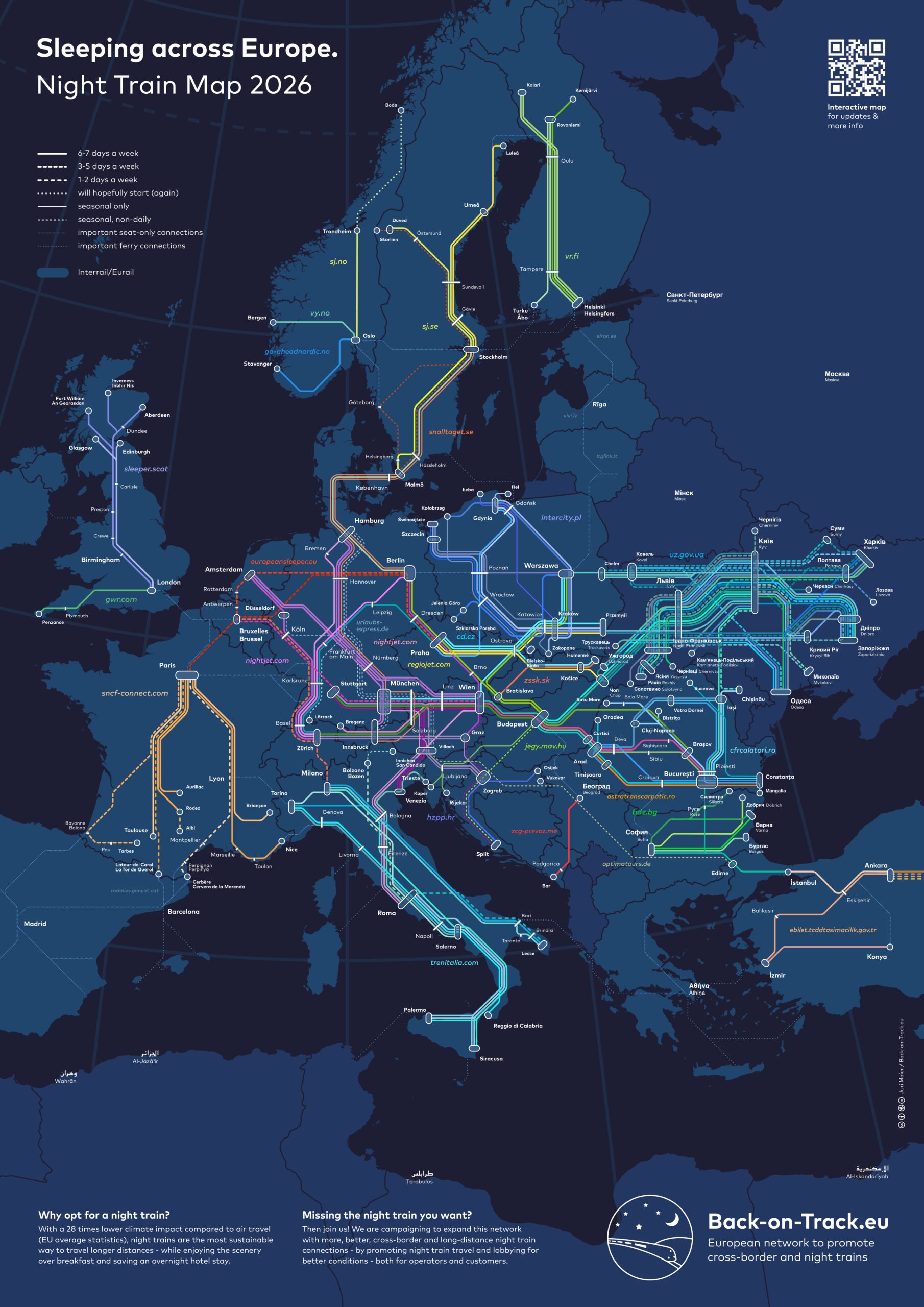
Night train enthusiasts from Back-on-Track.eu gathered connection data from the 205 regular sleeper lines in Europe to present their 2026 interactive European night train map. This map is the most comprehensive and up to date guide to night trains in Europe.
The release comes at an increasingly important time to highlight the importance of night train travel as a viable, sustainable solution to connect Europe for passengers amid a looming fuel crisis and growing demand for accessible and sustainable travel options. Despite the climate emergency, short haul flights pick up frequency while night trains are being rolled back in Europe.
The map displays every night train connection across the continent in one transport-network style map, while the organisation’s website provides a database with more detailed info about each connection and booking tips. The 2026 edition shows five new connections – European Sleeper’s Paris–Berlin line, new PKP routes linking Poland to Praha and München, and a planned Bruxelles–Milano service. At the same time, ten lines have disappeared, notably several popular ÖBB Nightjet routes and the 1,456 km long Stockholm-Narvik link, one of the longest night train routes in Europe.
New lines added on the 2026 map:
ČD: Praha = Przemyśl
European Sleeper: Paris = Berlin
European Sleeper: Bruxelles/Brussel = Milano
PKP: Gdynia = Praha
PKP: Przemyśl = München
VR: Helsinki = Kolari (1 of 2)
(excluding changes in Ukraine)
Lines removed on the 2026 map:
BDŽ: Sofia = Varna (1 of 3)
BDŽ: Sofia = Burgas (1 of 2)
CFR: București = Sighetu Marmației
HŽPP: Split = Vukovar
ÖBB: Paris = Berlin
ÖBB: Paris = Wien
ÖBB: München = La Spezia
ÖBB: Wien = La Spezia
SJ: Göteborg = Duved
SJ: Stockholm = Narvik/Áhkanjárga
SJ: Stockholm = Luleå (1 of 2)
(shortened) ÖBB: Bratislava = Split (now from Vienna)
(excluding changes in Ukraine)
The biggest obstacle for night trains in Europe and the main reason why the train to Narvik was stopped is the lack of investment in rolling stock, says Juri Maier, Back-on-Track chair, who designed the map. “The demand is there, and competition with planes is not as fierce anymore. Concepts exist to carry up to 750 sleeping passengers per train, which would make operations profitable on many routes. But to unlock this potential, we need significant investments – now.”
Another challenge is ongoing track works across the continent, which disrupts night train schedules. However, by 2032, new infrastructure is expected to make far better connections across Europe viable. “The new Bruxelles–Milano line would truly fill a gap on our map, but the route through Switzerland will be an operational challenge. We’re excited to see if it works out,” says Giovanni Antoniazzi, Back-on-Track vice chairman, a spatial data scientist based in Amsterdam who coordinated the setup of the Open Night Train Database.
The interactive map is freely available at back-on-track.eu/night-train-map where it is also possible to order a printed poster. The map may be reproduced under a Creative Commons license, the database is publicly available on Github.
Media:
Pingback: Подорожі Європою стали простішими: з’явилася інтерактивна карта нічних потягів – РеІнформ
Pingback: Infolettre juin 2026 – Oui au train de nuit !
Comments are closed.