
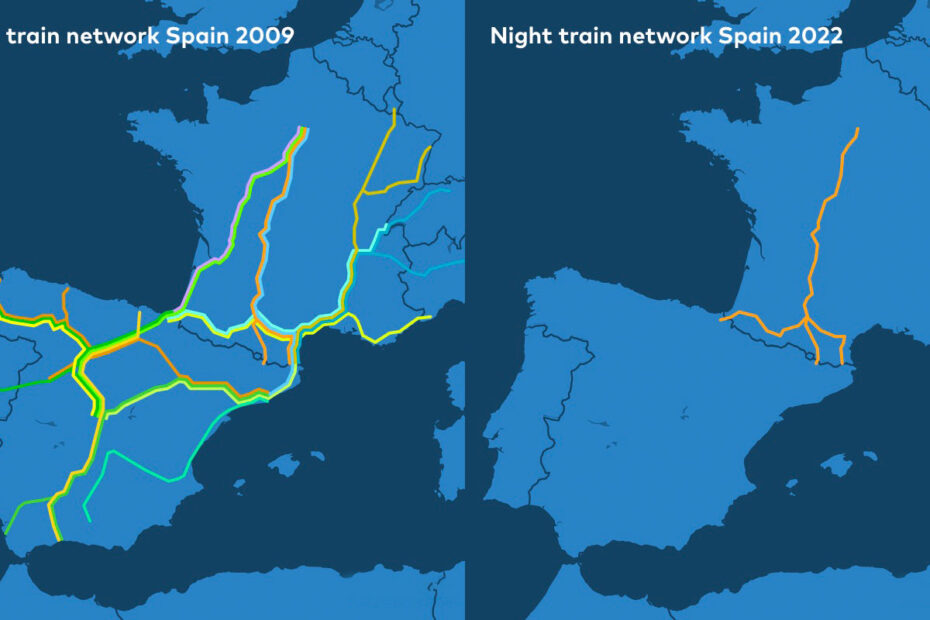
How infrastructure managers should price track access is an active technical debate across Europe. The European Commission’s 2025 TAC guidelines set a framework, but the details are still contested: how services are segmented, which costs are treated as shared, how demand elasticity is estimated. Spain’s infrastructure manager Adif has now commissioned the consultancy Deloitte to restructure its track access charges, partly in response to pressure from new operators seeking lower fees. This reform is an opportunity to raise what the standard methodology gets wrong for night trains.
What are Track Access Charges (TAC) all about?
In order to recover totally or partially maintenance costs, and in some cases manage debt incurred in building new sections of the network, infrastructure managers charge for the usage of rail sections, stations, and other elements. To organise charges, service and line types are organised into segments, and within each segment mostly per kilometre fees are charged. If charges are too low, the network may suffer from under-investment or require large sums of state funds. But if they are too high, some services can be expelled from the network, which also results in less passengers served and less funding.
What’s the problem, in particular for night trains?
The European Commission’s 2025 TAC guidelines already recognise the need to balance cost recovery against market development, but we are concerned with how the parameters are set. How should services be segmented? What is a fair (and effective) way of pricing access that is compatible with more traffic, and more modal share in favour of rail?
Over-indexing on high per-km fees makes very long-distance rail structurally unviable.
A service covering 1,000 km accumulates a charge burden with no equivalent in competing modes — aviation benefits from a thinner cost structure, including important tax exemptions. A uniform per-km TAC applied to a Barcelona–Lisbon or Madrid–Paris night train is not recovering marginal cost; it is imposing a distance penalty on the only mode that avoids airport congestion and carbon externalities on those corridors. Additionally, very long-distance rail suffers from increased personnel costs, with rolling stock cost spread across fewer services, and higher risk of disruption. Cross-border services also pay the cost of additional regulatory cost. These services are precisely the core of a pan-European rail network, and they need their own segment, and charges that don’t impose a distance penalty on them.
Night infrastructure is a sunk cost that is not recovering its potential.
Outside utilised maintenance windows, the network is already built, powered, signalled, and staffed — regardless of traffic. Every night train slot that does not run is not a saving; it is a loss of the only revenue those fixed assets could generate in those hours. A TAC that prices night movements at the same rate as peak daytime use discourages use of capacity already paid for. Crucially, these trains do not compete for congested capacity: they run at night, on underused infrastructure, between cities with no reasonable rail alternative today. When cost causation is followed honestly, the correct charge for a night movement approaches wear only.
In relation to track access charges, Back-on-Track requests that:
- Night train services are modelled as a distinct segment with a realistic demand elasticity profile, as the European Commission calls for (C/2025/2606), including the possibility of charges below marginal cost where Member States apply Article 34 compensation mechanisms, as already implemented in France and Belgium.
- Realistic operating conditions are considered for night train services, including the ramp-up period before routes reach commercial maturity, and the constraints on accessing appropriate rolling stock.
- Very long distance and cross-border routes are priced according to their central role in the pan-European network, not penalised by distance accumulation. The relevant cost driver is the slot used, not the kilometres covered.
- Public services (PSO), including regional and suburban, are not treated as captive segments bearing higher mark-ups. Where public funding already falls short of current service levels, a higher charges cuts frequencies rather than recovering costs — and erodes the feeder network that long-distance and night trains depend on.
The details of reforms like this will determine whether Madrid–Paris or Barcelona–Frankfurt become real rail journeys, or stay journeys that only aviation serves. We will be watching Adif’s updated charges closely — and engaging with other European infrastructure managers on the same questions.