
(Updated, 2025-12-09)
Switzerland’s revised CO2 Act stipulates how the ‘proceeds from the auctioning of emission allowances for aircraft’ are to be used: firstly, ‘for measures to promote cross-border long-distance passenger transport by rail, in particular for the promotion of night trains’. And secondly, ‘for measures to reduce greenhouse gas emissions in air transport, in particular for the development and production of renewable synthetic aviation fuels’.
A maximum of 30 million Swiss francs per year was earmarked for night train connections. Last year, with the aim of making savings, Parliament already cut the budget by CHF 20 million from the CHF 30 million that had been earmarked to ensure the promotion of international rail transport from 2025 to 2030. The wording of the law does not allow these reduced funds to be returned to the general federal budget, meaning that the 20 million Swiss francs are automatically allocated to air transport.
On 12 November 2025, the Finance Committee of the Council of States proposed a further cut of 10 million, which would mean that the night train from Basel to Malmö would not be able to start in April 2026, as according to the Swiss Federal Railways, funding is not guaranteed.
A spontaneous coalition of transport policy organisations, including the Swiss Public Transport Interest Group (IGöV), the Swiss Transport Club (VCS), the environmental organisation umverkehR / actif-trafiC, the Swiss Public Transport Association (VöV), the Association representing the interests of public transport customers in Switzerland (Pro Bahn Schweiz), the Coalition for Air Transport, Environment and Health (KLUG / CESAR) and Back-on-Track Switzerland, have been appealing to the members of the Swiss Parliament to grant the federal subsidy for this night train after all. This is the only way to ensure the future-oriented and climate-friendly development of international passenger transport.
More than 25.000 signatures of the Petition “Jetzt Nachtzug nach Malmö retten! / Sauver maintenant le train de nuit Bâle-Malmö !” were collected within 20 days and handed over to the Federal Parliament on 2 December 2025.
Unfortunately, this did not impress the delegates from the Swiss Cantons in the upper house (Ständerat).
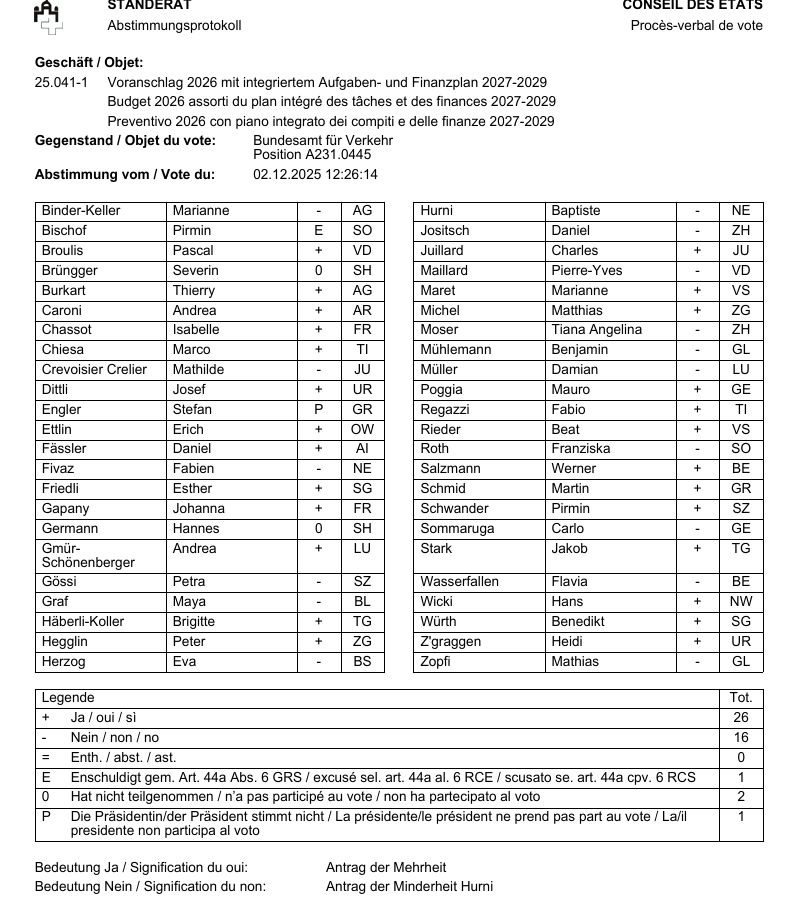
Voting result in the Ständerat on 2nd Dec, 2025.
The final debate:
On 9th of December the National Council (Nationalrat), the lower house of the Swiss parliament finally cancelled the night train from Basel to Malmö in its session with a tiny 99:92 majority, following the earlier vote by the upper house, the State Council (Ständerat). This means the end for the night train from Basel to Malmö nicknamed “Aurora”. As the money came form aviation tax, the means will not be available for other budget positions but need to be spent on other decarbonisation measures, namely funding of so-called “sustainable aviation fuels (SAF)”. The Swiss Federal Railways (SBB) has already announced that the train will not be running without subsidies and that all passengers will be refunded.
Core argument of opponents in the debate were that night trains cannot be effective in reducing flight passenger numbers as flights would remain a quicker and cheaper alternative (Pahud, SVP). While this claim is obviously contradicted by booking figures the other core argument was the cost-efficiency of the measure as alternative measures would be more efficient in comparison.

Voting result in the Nationalrat on 9th Dec, 2025
Core argument of opponents in the debate were that night trains cannot be effective in reducing flight passenger numbers as flights would remain a quicker and cheaper alternative (Pahud, Swiss Peoples Party). While this claim is obviously contradicted by booking figures the other core argument was the cost-efficiency of the measure as alternative measures would be more efficient in comparison. (Farinelli / Liberals).
This claim was previously falsified by Back-on-Track as it ignores radiative forcing of aviation emissions:
The night train has 360 seats and night trains have an expected average annual occupancy rate of 70%. That is an average of 245 passengers on 156 journeys in each direction, or 76,440 passengers. Dividing 10 million Swiss francs by 76,440 tickets gives a figure of around CHF 131 per passenger.
This amount would alternatively be used to promote sustainable aviation fuel (SAF). This costs 2.57 CHF per litre, 1.81 CHF more than kerosene. (Average prices for 2023 according to the BAZL, p. 56) CHF 131 could therefore subsidise 72.4 litres, neutralising 228 kg of CO₂ emissions from the combustion of kerosene (3.16 kg per litre according to myclimate.ch).
The Basel–Copenhagen route is only served once a week non-stop. Most connections have a stopover and cause between 120 and 150 kg of CO₂ per direction. The situation is similar for direct flights from Zurich. At first glance, purchasing SAF appears to be slightly more effective.
However, the climate impact of flying is not limited to CO₂: if the radiative effect of contrails is also taken into account, a single flight from Basel to Amsterdam to Copenhagen already corresponds to around 400 kg of CO₂ equivalents (according to myclimate.ch), while an average direct flight from Zurich to Copenhagen corresponds to 260 kg.
If we subtract the approximately 30 kg of CO₂ equivalents generated by a night train journey on the same route (according to ecopassenger.org), this leaves a difference of 230-370 kg of CO₂ equivalents that can be saved by switching to the night train.
Subsidising a night train journey with CHF 131 would therefore be more effective in reducing greenhouse gas emissions in any case.
We’d like to add that this is based on prices for biogenic SAF, which is not available in the numbers required to decarbonize aviation. According to Lufthansa, SAF from surplus electricity (PtL) is still ten times more expensive than kerosene
A short history of transport emissions reduction in 🇨🇭:
2018
120 M CHF
A 120 M Swiss Francs proposal for international trains with money coming from new flight tax.
2021
Climate Law 1 collapsed with unexpected “No”.
2024
30 M CHF
30 M for cross-border trains was decided with Climate Law 2, plans to fund hashtag#nighttrains ZH-Barcelona and ZH-Roma
2025
10 M CHF
10 M proposed in budget, plans to fund BS-Malmö
9. 12. 2025
0 M CHF
no funding approved for 2026
The Swiss Federal Railways night train was planned to depart in April 2026.
In cooperation with RDC Germany, Swiss Federal Railways (SBB) planned to operate a EuroNight connection from Basel SBB via København to Malmö from 15 April 2026. Three weekly journeys per direction were planned.
The EuroNight offered space for around 350 passengers in sleeper, couchette and seating carriages, including a barrier-free compartment. A bistro was planned for travellers between Basel and Padborg. Stopovers included Basel Bad Bf, Freiburg (Breisgau) Hbf, Karlsruhe Hbf, Mannheim Hbf, Frankfurt (Main) Süd, Hamburg Hbf, Padborg, Kolding, Odense, Hoeje Taastrup and Københavns Lufthavn. A stop at KøbenhavnCentral Station was not planned due to time constraints, but the Danish capital can be reached from Hoeje Taastrup or Kobenhavns Lufthavn in around 15 minutes by S-Bahn.
The approach taken by Swiss Federal Railways was the result of close consultation with the Federal Office of Transport (BAV). The reason for the early start of sales before the final approvement in parliament was an official commitment as a basis for business: the BAV has classified the connection as eligible for funding, as international night trains cannot be operated economically without federal subsidies. This commitment gave SBB the necessary planning security to anchor the connection for the new Basel–Malmö night train in the timetable and to start ticket sales early as usual.
Further information:
- Joint Media Release from 2025-11-12 (in French)
- Joint Media Release on the handover of 25.000 signatures, 2005-12-02 (in German)
- The debate and vote on Dec 9th in the National Council (in German, French and Italian) and on Dec 8th
Pingback: Petitie gestart om nachttrein Basel-Kopenhagen-Malmö te redden nu Zwitserse subsidie ter discussie staat - RailTech.be
Pingback: Lancement d’une pétition pour sauver le train de nuit Bâle-Copenhague-Malmö, alors que la subvention suisse fait l’objet d’un débat - RailTech.be
Comments are closed.